
What if the key to fixing persistent “tech neck” isn’t more willpower, but a better connection between your brain and your muscles? Many professionals in Charlotte find themselves trapped in a cycle of temporary relief, often worrying that their spinal adjustments won’t “stick” once they return to their desks. It’s frustrating to feel that familiar pull in your neck and shoulders, especially when you aren’t sure which movements actually create lasting change.
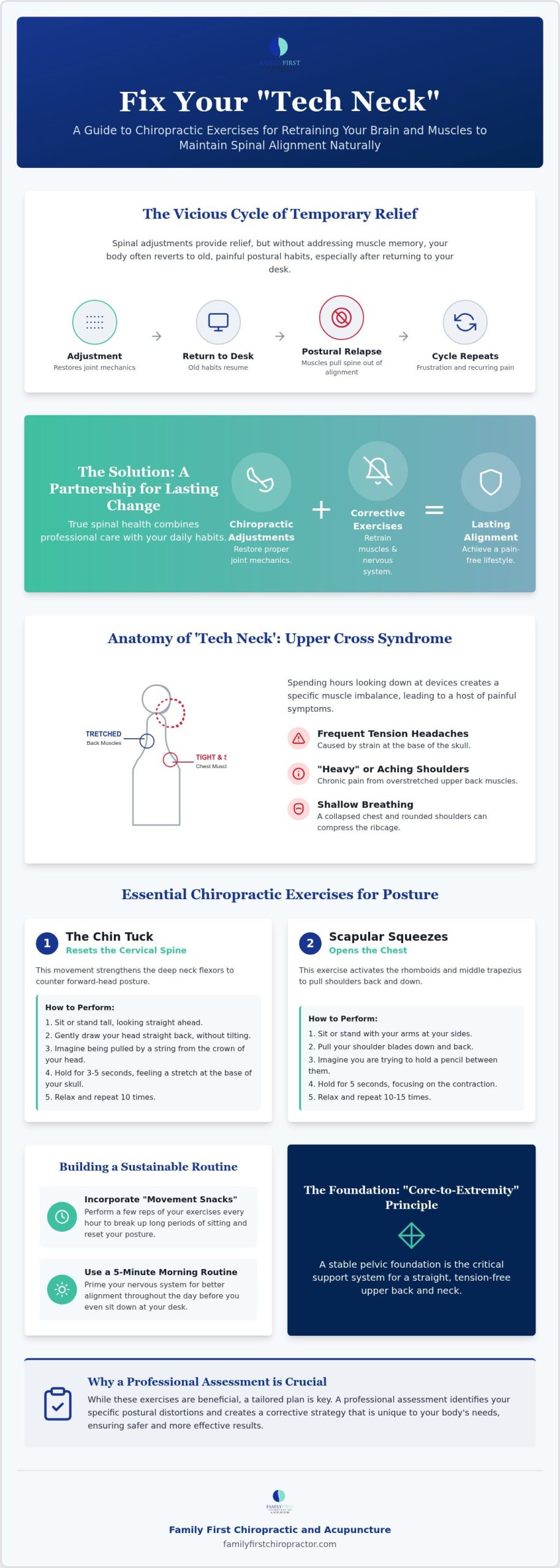
We believe that true spinal health is a partnership between professional care and your daily habits. This guide introduces the specific chiropractic exercises for posture designed to bridge the gap between clinical adjustments and a pain-free lifestyle. You’ll learn how these professional-grade corrective movements retrain your nervous system to maintain alignment naturally. By the end of this article, you’ll have a clear, sustainable plan to reduce workday tension and achieve a visible improvement in your standing and sitting posture.
Key Takeaways
- Understand why spinal adjustments require targeted muscle retraining to prevent your body from reverting to familiar, slouched positions.
- Learn five essential chiropractic exercises for posture that you can easily perform in your home office without the need for specialized equipment.
- Discover the “Core-to-Extremity” principle and how a stable pelvic foundation supports a straight, tension-free upper back.
- Incorporate “movement snacks” and a five-minute morning routine to prime your nervous system for better alignment during long workdays.
- Recognize the importance of a professional assessment to identify specific postural distortions and create a corrective plan tailored to your body.
The Link Between Chiropractic Care and Postural Correction
Posture is often misunderstood as a static pose, but it’s actually a dynamic relationship between your nervous system and your musculoskeletal frame. Your brain constantly processes signals to maintain good posture, adjusting muscle tension to keep you upright against the relentless pull of gravity. While a chiropractic adjustment restores proper joint mechanics, the surrounding soft tissues often remain “trained” to support an old, imbalanced position. This is where chiropractic exercises for posture become essential. They act as a neurological reset, teaching your muscles how to support the new, healthy alignment established by your chiropractor. Without this active retraining, your body’s internal “muscle memory” may simply pull your spine back into its previous state of dysfunction.
Why Adjustments Need Corrective Movement
Think of your spine and muscles as being in a constant tug-of-war. When a vertebra is misaligned, the attached muscles must shorten or weaken to compensate for the shift. If we only adjust the bone without addressing these soft tissue changes, those stubborn muscles will eventually pull the joint back into its old, painful spot. This cycle occurs because of proprioception, which is your body’s innate ability to sense its position in space. By using corrective exercises, we recalibrate the sensors in your joints and tendons. This creates a stable foundation that holds your adjustment longer, allowing for deeper healing and systemic harmony. Postural Neurology is the brain’s control over spinal muscles.
Identifying ‘Tech Neck’ and Modern Postural Decline
Modern life places a unique strain on our bodies, particularly for Charlotte professionals who spend four or more hours daily looking down at digital devices. This repetitive forward-head posture leads to a condition known as Upper Cross Syndrome. In this state, the muscles in the front of your chest become overly tight while the muscles in your upper back become weak and overstretched. This specific imbalance is a frequent driver of chronic left shoulder pain and restricted movement in the neck. You’ll often notice early warning signs like frequent tension headaches, a persistent “heavy” feeling in the shoulders, or even shallow breathing as your ribcage becomes compressed. Recognizing these signals early allows us to implement chiropractic exercises for posture before the physical changes become more permanent. By identifying these postural distortions during an exam, we can target the exact muscles that need restoration and alignment.
Top 5 Chiropractic Exercises for Posture You Can Do at Home
Taking control of your spinal health doesn’t require a gym membership or expensive gear. For professionals working from home in Charlotte, the most effective chiropractic exercises for posture are those that can be performed in the small gaps between meetings. These movements focus on quality over quantity. Each repetition aims to remind your nervous system of its ideal alignment. Before you begin this routine, it’s wise to consult your chiropractic center to ensure these movements are appropriate for your specific spinal needs. While these exercises provide a solid foundation, you can find additional inspiration in this guide to 12 Exercises to Improve Posture.
The Chin Tuck: Resetting the Cervical Spine
To perform a chin tuck, sit tall in your chair and look straight ahead. Without tilting your head up or down, slowly draw your head straight back as if you’re being pulled by a string from the crown of your head. You should feel a gentle stretch at the base of your skull and a tightening in the front of your neck. A helpful sign of correct form is the temporary appearance of a “double chin.” This movement strengthens the deep neck flexors. These are the primary muscles responsible for countering the forward head posture common in desk-bound roles.
Scapular Squeezes: Opening the Chest
Many of us carry tension in our upper backs, leading to rounded shoulders and a collapsed chest. Scapular squeezes address this by activating the rhomboids and middle trapezius muscles. While seated or standing, pull your shoulder blades down and back. Imagine you’re trying to hold a pencil between your blades. Hold this position for five seconds before relaxing. This exercise helps restore balance to the torso, though many patients find that combining this with therapeutic massage for neck pain charlotte is the best way to release the tight pectoral muscles that often resist this movement. For those who also experience discomfort in the joint itself, pairing scapular work with corrective exercises for shoulder pain can address the underlying mechanical imbalances that prevent full recovery.
The Wall Slide: Dynamic Mobility
The wall slide is a powerful tool for improving thoracic mobility and shoulder range of motion. Stand with your back flat against a wall, ensuring your heels, glutes, and head are in contact with the surface. Raise your arms to shoulder height with elbows bent, creating a “W” shape. Slowly slide your arms upward while keeping your elbows and wrists pressed against the wall. Perform 10 slow repetitions, three times daily. This dynamic movement encourages systemic harmony by opening the ribcage and supporting a more upright, confident stance. If you find these movements difficult to complete with full range of motion, a professional assessment at Family First Chiropractic can help identify the underlying restrictions holding you back.
The Science of Functional Movement and Stability
Movement isn’t just about muscle strength; it’s about the sequence in which your body recruits those muscles. The Core-to-Extremity principle suggests that stability must originate at the spine before functional movement can happen in the shoulders or hips. When your central axis is unstable, your body recruits smaller, less efficient muscles to do the heavy lifting. This eventually leads to the fatigue and slumping many of us feel by mid-afternoon. Integrating specific chiropractic exercises for posture helps retrain this sequence, ensuring your foundation is secure and your movements remain fluid.
Your diaphragm serves as a critical bridge between your respiratory system and your postural frame. It acts as an internal pressure regulator that stabilizes the spine from the inside out. When you breathe shallowly due to a hunched position, you lose this internal support, forcing your neck and back muscles to work twice as hard to keep you upright. For patients in Charlotte dealing with deep-seated tissue restrictions that hinder this stability, we often recommend softwave therapy. This advanced technology uses electro-hydraulic shockwaves to stimulate tissue recovery, making it easier for your body to adopt these new, healthier movement patterns.
Thoracic Extension: The Antidote to Slouching
The thoracic spine, or your mid-back, is designed for rotation and extension, but long hours at a desk often turn it into a rigid, forward-leaning curve. This stiffness isn’t just a comfort issue. Restricted thoracic mobility can significantly reduce lung capacity by preventing the ribs from fully expanding during inhalation. To combat this, try a seated thoracic extension. Sit in a chair with a mid-height back, place your hands behind your head, and gently arch your upper back over the top of the chair while keeping your lower back still. This simple movement restores extension to the vertebrae, allowing for a more open chest and easier breathing throughout your day.
Pelvic Tilts: Finding Your Neutral Spine
Think of your pelvis as a bucket of water. If the bucket tilts forward, water spills out the front, creating an exaggerated arch in your lower back called an anterior pelvic tilt. If it tilts backward, water spills out the rear, flattening your natural lumbar curve in a posterior tilt. Finding your neutral spine means keeping the “bucket” level so no water spills. Because your lower body alignment dictates how your upper back sits, mastering pelvic tilts is a vital part of any routine involving chiropractic exercises for posture. When the pelvis is level, the rest of the spine can stack effortlessly, reducing the muscular effort required to stay upright.
Creating a Sustainable Posture Routine for Charlotte Professionals
Many patients in Charlotte’s fast-paced banking and technology sectors feel they lack the time for a dedicated, hour-long exercise program. We address this common hurdle by introducing “movement snacks,” which are brief, intentional intervals of activity performed throughout the workday. These chiropractic exercises for posture are designed to maintain the integrity of your spinal alignment without requiring you to leave your office or change into athletic gear. Consistency is the primary driver of neurological change. It’s significantly more effective to perform these movements for a few minutes every day than to attempt a long, intense session once a week.
A five-minute morning routine is an excellent way to prime your nervous system for the day ahead. This short window of time allows you to wake up the postural muscles that often go dormant during sleep. Simple movements like gentle neck rotations or the pelvic tilts discussed earlier help signal to your brain that it’s time to activate your internal stabilizers. By establishing this habit, you ensure your body is physically prepared for the demands of a long day of meetings or deep analytical work. This proactive approach helps you maintain vitality and focus from your first cup of coffee until you clock out.
The ‘Desk Reset’ Strategy
Working in a high-pressure environment often leads to “postural creep,” a phenomenon where your shoulders slowly rise toward your ears and your chin drifts toward your screen as the day progresses. To combat this, implement a 60-second reset every hour. You can set a silent timer on your phone or computer as a gentle reminder to check in with your body. This frequent recalibration prevents the accumulation of tension that often leads to evening headaches or stiffness. Use this quick checklist to stay aligned:
- Place both feet flat on the floor to stabilize your pelvis and lower back.
- Perform a single, slow chin tuck to reset the cervical spine and reduce neck strain.
- Drop your shoulders away from your ears and gently squeeze your shoulder blades together.
- Take one deep, diaphragmatic breath to engage your internal stabilizers and oxygenate your system.
Ergonomics: Supporting Your Exercises
Even the most diligent routine of chiropractic exercises for posture can’t fully overcome a poorly configured workspace. Your monitor should be positioned at eye level to prevent the neck from craning forward, and your chair must provide adequate lumbar support to maintain the natural curve of your lower back. Position your keyboard and mouse so your elbows rest at a comfortable 90-degree angle. This setup reduces the mechanical stress on your joints, allowing your corrective movements to be more effective. At Family First Chiropractic, we provide personalized ergonomic advice during our consultations to ensure your home or office environment supports your long-term healing journey. Schedule your postural assessment in Charlotte today.
How Family First Chiropractic Personalizes Your Posture Plan
While the home-based movements we’ve discussed provide a vital foundation, true postural transformation begins with a professional assessment. Every body carries a unique history of injuries, work habits, and physical stressors that shape its current alignment. Dr. St. Germain uses detailed physical and digital examinations to identify specific postural distortions that might be invisible to the untrained eye. By pinpointing exactly where your frame has compensated for past strain, we can develop a targeted program of chiropractic exercises for posture that addresses your specific needs rather than a generic set of movements. This clinical starting point ensures that your efforts are directed toward the areas that will yield the most significant improvements in your daily comfort.
Beyond the Adjustment: Our Corrective Philosophy
We believe that a healthy spine requires more than just a single adjustment; it requires a comprehensive strategy for restoration and systemic harmony. Our clinic provides customized corrective exercise programs that serve as the essential partner to your spinal care. We often integrate advanced technologies like Softwave therapy to break up deep-seated scar tissue that may be physically preventing you from achieving proper alignment. This mechanical release, combined with the regenerative benefits of Redlight therapy, accelerates tissue recovery and makes your corrective movements significantly more effective. For patients seeking a broader approach to chronic pain and stress relief, our acupuncture wellness center services offer a complementary path to restoring systemic balance alongside your corrective exercise plan. Throughout this process, our team maintains a warm, family-oriented atmosphere that ensures you feel supported in every step of your health journey. You aren’t just another patient on a schedule; you’re a partner in a long-term plan for vitality.
Take the First Step Toward Better Posture
Your first visit to our Charlotte office focuses on a thorough evaluation of your current functional movement and spinal health. We take the time to explain the reasoning behind our strategies, ensuring you feel fully informed and prepared for your care. Improving your posture offers benefits that extend far beyond simple pain relief. It enhances your energy levels, boosts your professional confidence, and supports a more active, pain-free lifestyle for years to come. By prioritizing the health of your nervous system and musculoskeletal frame, you’re investing in your future quality of life. We invite you to experience a holistic approach to wellness that prioritizes your long-term success and personal comfort. Contact Family First Chiropractic today to schedule your initial posture evaluation and begin your path toward lasting alignment and health.
Your Path to Lasting Alignment and Vitality
Achieving a healthier spine is a collaborative journey that combines expert clinical care with intentional daily habits. Throughout this guide, we’ve explored how your nervous system governs your physical position and how specific chiropractic exercises for posture serve as the essential bridge between a spinal adjustment and long-term stability. By adopting “movement snacks” and optimizing your workspace, you can effectively retrain your body to maintain its natural, pain-free alignment even during the most demanding workdays.
We’re here to support your transition from persistent tension to effortless movement. Led by Dr. St. Germain, our Charlotte clinic integrates advanced Softwave and Redlight technology with customized corrective exercise plans tailored to your unique physiological needs. This holistic approach ensures that your care is as precise as it is compassionate. Schedule Your Posture Evaluation at Family First Chiropractic in Charlotte today to begin your transformation. You deserve a life defined by energy, confidence, and systemic harmony.
Frequently Asked Questions
How often should I do chiropractic exercises for posture?
You should perform chiropractic exercises for posture daily to achieve the best results. Consistency is the primary driver of neurological change; it’s more effective to do three minutes of movement every few hours than a single long session once a week. Frequent “movement snacks” keep your nervous system engaged and prevent your body from defaulting to a slouched position during long workdays.
Can I fix 20 years of bad posture with these exercises?
You can certainly improve your posture even after 20 years of poor habits. The human body remains adaptable throughout life, which is a concept known as neuroplasticity. While structural changes take time, retraining your muscles to support your spine correctly will lead to significant reductions in tension and visible improvements in how you stand and sit.
Will these exercises hurt if I have a pinched nerve?
These exercises shouldn’t cause pain if you have a pinched nerve, but you must approach them with caution. If a nerve is compressed, certain movements might increase irritation. It’s essential to have a professional evaluation at our Charlotte clinic to ensure your specific routine is safe and supportive of your recovery before you begin.
Do I need special equipment like foam rollers or bands?
You don’t need any specialized equipment like foam rollers or resistance bands to begin this program. The most effective chiropractic exercises for posture, such as chin tucks and wall slides, utilize your own body weight and a flat wall. This makes it easy to maintain your routine whether you’re at home, in a corporate office, or traveling.
Should I do these exercises before or after my chiropractic adjustment?
It’s generally best to perform your exercises after your chiropractic adjustment. The adjustment restores proper joint mechanics and alignment; the exercises then work to “lock in” that position by strengthening the surrounding muscles. This partnership ensures that your clinical results last longer as you go about your daily activities.
What happens if I feel sharp pain while doing a posture stretch?
Stop immediately if you feel sharp, stabbing, or radiating pain during any movement. While a gentle stretch sensation is normal, sharp pain is a warning signal from your nervous system that a tissue is being overstressed or a joint is improperly loaded. Consult with Dr. St. Germain to modify your form or address the underlying restriction.
Can children and teenagers do these corrective exercises?
Children and teenagers can absolutely benefit from these corrective movements. With the rise of “tech neck” among younger generations, early intervention is key to preventing long-term spinal distortions. These exercises are gentle and safe; they help young people develop a strong brain-body connection and healthy movement habits that last a lifetime.
How long does it take to see visible results in my posture?
Most patients begin to feel a difference in their comfort and “height” within the first two weeks of consistent practice. Visible changes in your standing profile typically become more apparent after four to six weeks of daily commitment. This timeframe allows your muscles to adapt and your nervous system to fully accept the new postural baseline.
