Imagine trying to drift off to sleep, only to find that every time you roll onto your left side, a sharp throb or persistent ache keeps you wide awake. It’s incredibly frustrating when a simple movement like reaching for a seatbelt or lifting a grocery bag becomes a source of dread. Many people living with left shoulder pain feel a deep sense of anxiety, wondering if the discomfort is a localized injury or a warning sign of something more serious like referred heart pain. You aren’t alone in these concerns, and your desire for clarity and comfort is completely valid.
This article will help you discover why your shoulder hurts, how to identify serious red flags, and the most effective non-invasive treatments for lasting relief. We’ll examine the root causes of musculoskeletal dysfunction and preview how a holistic approach, incorporating chiropractic care and advanced therapies like Softwave, can restore your vitality. By understanding the mechanical function of your joints and the systemic harmony of your body, you can move from a state of worry to a path of steady, professional recovery.
Key Takeaways
- Learn to distinguish between mechanical strain and critical warning signs to gain peace of mind regarding your physical health.
- Identify how common issues like rotator cuff tendonitis or postural imbalances create persistent left shoulder pain during daily activities.
- Discover how the combination of chiropractic care and acupuncture restores joint rhythm while encouraging the body’s natural anti-inflammatory response.
- Understand how advanced Softwave and Redlight therapies accelerate tissue healing at a cellular level without the need for invasive surgery.
- Explore the benefits of a personalized recovery plan that uses corrective exercises to build lasting strength and prevent future discomfort.
Understanding Left Shoulder Pain: Anatomy and Critical Warning Signs
Left shoulder pain is a complex experience that can stem from localized joint dysfunction, neurological signals from the spine, or referred discomfort from internal organs. Because the shoulder is the most mobile joint in your body, it requires a delicate balance of stability and flexibility to function without discomfort. This vast range of motion is possible because the glenohumeral joint is held together by a sophisticated network of soft tissues rather than deep bony sockets. When this balance is disrupted, daily tasks like dressing or driving can become painful reminders of an underlying issue.
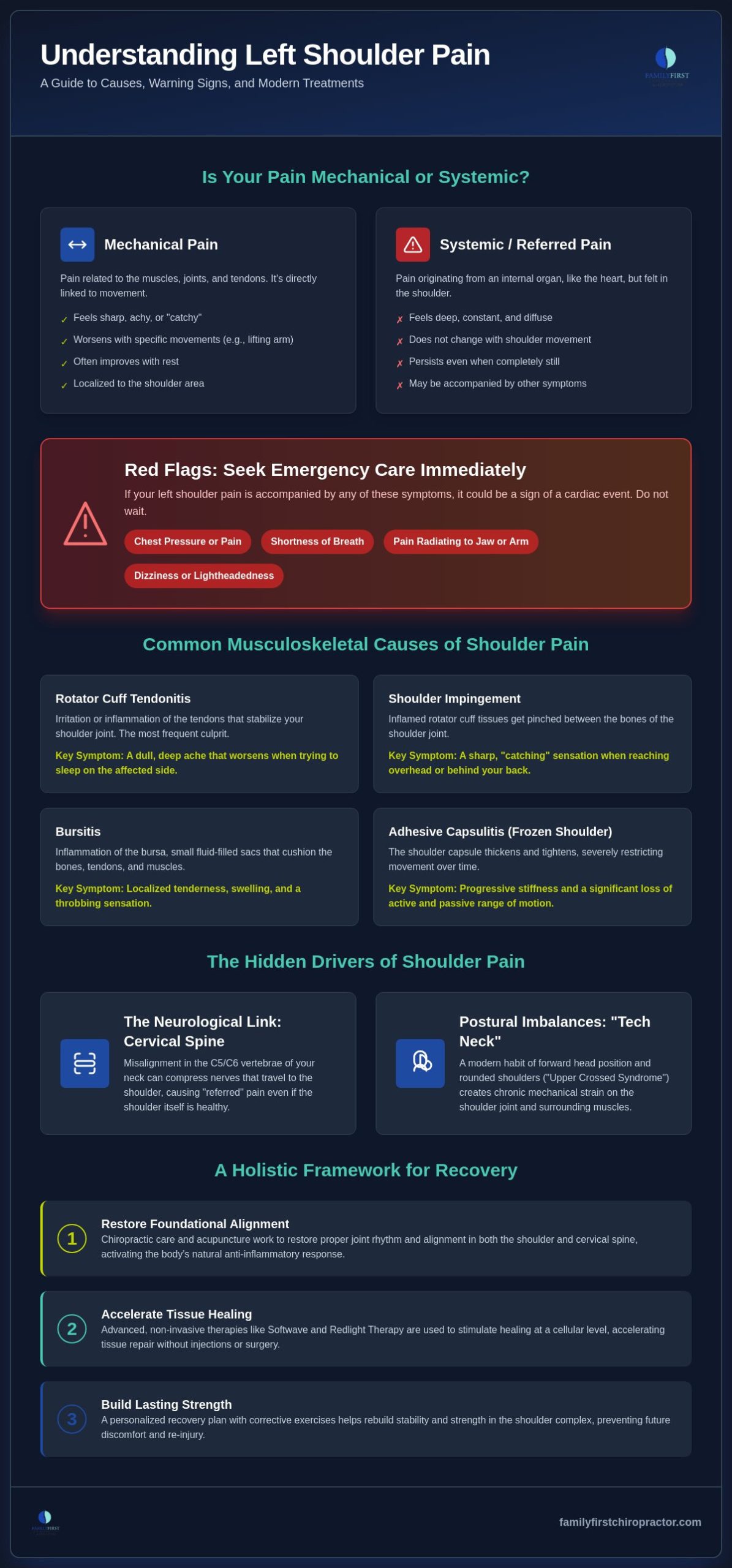
Distinguishing between mechanical and systemic pain is the first step toward recovery. Mechanical pain is movement-based; it typically feels sharp or catchy when you lift your arm or reach behind your back. Systemic pain, on the other hand, is often deep and constant, persisting even when the arm is completely still. Understanding common shoulder problems requires an appreciation for how these different signals manifest in your daily life. Because the nerves that serve the heart and diaphragm share sensory pathways with the left shoulder, it isn’t uncommon for your brain to interpret internal distress as a musculoskeletal ache.
The “Golf Tee” Analogy of Shoulder Stability
To visualize how your shoulder works, imagine a golf ball sitting on a tiny tee. The tee represents the shallow socket of your shoulder blade, and the ball is the head of your upper arm bone. This shallow connection allows for incredible movement, but it relies heavily on the labrum, a ring of cartilage that deepens the socket. Surrounding this is the joint capsule, which produces nourishing synovial fluid to reduce friction. If your humerus shifts even slightly out of its centered position, it creates abnormal wear on these structures, leading to persistent left shoulder pain and restricted movement.
When to Seek Emergency Care: The Red Flags
While most cases of shoulder discomfort are related to muscles or joints, certain symptoms demand immediate attention. You should seek emergency care if your shoulder pain is accompanied by chest pressure, shortness of breath, or pain radiating into your jaw. These can be signs of a cardiac event rather than a simple strain. It’s also vital to differentiate between sudden trauma and gradual onset. A fall that causes immediate swelling or a visible deformity may indicate a fracture or dislocation. If you experience unexplained pain that feels visceral and doesn’t change when you move your arm, a professional screening is essential to ensure your safety and well-being. To learn how a dedicated internist like John Abroon M.D. provides this level of diagnostic care, read more about personalized medical models.
Once urgent systemic issues are cleared, we often find that the source of persistent left shoulder pain lies within the complex network of muscles and tendons that facilitate movement. Rotator cuff tendonitis is perhaps the most frequent culprit, manifesting as a dull, deep ache that intensifies when you try to sleep on your side. This condition involves irritation of the tendons that stabilize the joint, often leading to a secondary issue known as shoulder impingement syndrome. If you feel a sharp, “catching” sensation when reaching overhead, it’s likely that these inflamed tissues are being pinched between the bones of the joint.
There are several other common causes of shoulder pain that involve the joint’s protective structures. Bursitis occurs when the small, fluid-filled sacs that cushion the joint become inflamed, resulting in localized swelling and a throbbing sensation. In more restrictive cases, patients may develop adhesive capsulitis, or “frozen shoulder.” This condition progresses through stages of increasing stiffness, eventually making it nearly impossible to move the arm through its normal range of motion. Identifying which of these mechanical issues is present allows for a more targeted and effective recovery plan.
The Neurological Link: Cervical Spine and Referred Pain
The cervical spine, specifically the C5 and C6 vertebrae, serves as the primary neurological hub for shoulder function. When these spinal segments lose their proper alignment, they can compress the nerves of the brachial plexus, which sends signals directly down your left arm. This “pinched nerve” often mimics a localized shoulder injury, causing pain or tingling even when the shoulder tissues themselves are healthy. By restoring alignment to the neck, we can often resolve “shoulder” pain that hasn’t responded to traditional local treatments.
Postural Imbalances and “Tech Neck”
Modern habits often lead to Upper Crossed Syndrome, a postural imbalance characterized by a forward-head position and rounded shoulders. This misalignment creates a significant mechanical disadvantage for the left shoulder, as the muscles on one side of the joint become chronically overstretched while others become excessively tight. Many people experience a left-side bias in this tension because of asymmetric desk setups or the habit of cradling a phone between the ear and the shoulder. These subtle daily strains eventually lead to chronic discomfort and reduced mobility. Understanding these postural drivers is why we focus on comprehensive evaluations at Family First Chiropractic and Acupuncture
A Holistic Framework for Recovery: Chiropractic and Acupuncture
Addressing persistent left shoulder pain effectively requires looking beyond the immediate area of discomfort to evaluate the systemic patterns of movement. While traditional approaches often rely on temporary masking of symptoms with medication, a holistic framework focuses on restoring the structural rhythm of the entire upper body. Chiropractic care and acupuncture work in tandem to address both the mechanical alignment of the skeleton and the underlying inflammatory response of the soft tissues. This partnership allows you to move from a state of reactive pain management toward a proactive, functional recovery that lasts.
Chiropractic Alignment for Shoulder Mechanics
Chiropractic adjustments for the shoulder focus on the foundational joints that support the arm’s weight, specifically the acromioclavicular (AC) and sternoclavicular joints. If these areas are restricted, the shoulder cannot rotate smoothly, which often leads to compensatory strains in the neck. We also prioritize thoracic mobility. A stiff upper back forces the left rotator cuff to work harder than intended during simple reaches. By restoring this spinal flexibility, we reduce the mechanical load on the shoulder. This conservative path provides a sustainable alternative to surgical intervention by allowing the body to heal in its natural alignment. If you’re evaluating your options, learning how to select the right chiropractic center in Charlotte can help ensure you receive integrated, technology-driven care rather than temporary symptom relief.
Acupuncture and Massage: Soft Tissue Synergy
Acupuncture offers a unique biological advantage by triggering the release of the body’s natural opioids and signaling the nervous system to reduce local inflammation. This is particularly helpful for conditions like shoulder impingement syndrome, where swollen tissues become trapped in narrow joint spaces. Because tendons naturally have a limited blood supply, acupuncture helps by improving microcirculation to these poorly vascularized areas. When we pair this with therapeutic massage to target trigger points in the levator scapulae and trapezius, we can break up scar tissue and adhesions that restrict your movement.
Combining these modalities creates a faster return to daily activity by addressing the injury from multiple angles. Once the acute inflammation is under control and your alignment is restored, the focus shifts toward functional corrective exercises. These movements reinforce your new alignment and build the necessary strength to ensure your left shoulder pain doesn’t return. This integrated approach ensures that we aren’t just treating a symptom, but rather supporting your body’s innate ability to maintain systemic harmony and long-term health.
Advanced Healing Technologies: Softwave and Redlight Therapy
When standard physical therapy doesn’t provide the expected results, it’s often because the damaged tissue has entered a dormant state where natural healing has stalled. This is particularly common with chronic left shoulder pain, where years of inflammation have led to scar tissue or calcification. For patients requiring a deeper medical evaluation, a specialistläkare långvarig smärta can offer a highly specialized assessment of persistent conditions. Advanced technologies like Softwave and Redlight therapy then offer a way to restart the body’s internal repair mechanisms at a cellular level, providing a biological stimulus that encourages the restoration of healthy, functional tissue.
Beyond these therapies, patients can also explore AI-Powered Physical Therapy to see how concierge-level technology and data-driven assessments can further refine a personalized rehabilitation plan.
The Science of Softwave for Tissue Recovery
Softwave therapy uses electro-hydraulic shockwaves to create a targeted “trick” on the nervous system and local tissues. By delivering these acoustic waves into the joint, the technology initiates a response that recruits dormant stem cells to the site of the injury. This process is essentially a non-invasive form of lithotripsy for the shoulder, which helps break down the painful calcium deposits often found in calcific tendonitis. During a session, you won’t experience needles or downtime. Instead, you’ll feel a sense of cellular activation as the waves identify and treat the root cause of your discomfort. This technology is a cornerstone of our Charlotte-based recovery plan, offering a path forward for those who wish to avoid surgery.
Redlight Therapy: The Cellular Powerhouse
Redlight therapy complements these shockwaves by focusing on the mitochondria, the energy-producing centers of your cells. By using specific wavelengths of light, this therapy penetrates deep into the shoulder joint capsule to stimulate ATP production. This increased energy allows cells to repair themselves more efficiently and significantly reduces chronic inflammation. Many patients find that Redlight therapy has a cumulative effect, notably reducing the morning stiffness that often accompanies long-term shoulder issues.
The synergy between these technologies represents a significant shift in how we approach musculoskeletal health. While chiropractic care ensures the joint is moving correctly, Softwave and Redlight therapy provide the biological energy needed for the soft tissues to heal. This combination is especially effective for patients who feel they’ve plateaued with other treatments. If you’re ready to experience these cutting-edge options for yourself, schedule a consultation at Family First Chiropractic and Acupuncture to begin your personalized healing journey.
Personalized Recovery in Charlotte: The Family First Approach
Recovery from persistent left shoulder pain isn’t a one-size-fits-all process because every individual carries tension and moves their body differently. Dr. St. Germain takes a methodical approach to your care, beginning with a thorough consultation that looks beyond the surface symptoms to find the true source of your discomfort. By evaluating your spinal alignment, soft tissue health, and daily movement patterns, we develop a customized care plan that respects your unique physiology. Our Charlotte center provides the convenience of having chiropractic care, acupuncture, and advanced technologies like Softwave under one roof, ensuring your recovery is both seamless and comprehensive.
When you prepare for your first visit, we recommend bringing any recent imaging reports or a list of current medications you’re taking. This information helps us build a complete picture of your health history so we can move forward with confidence. During this initial evaluation, we’ll discuss your goals for recovery and explain how our integrated triad of services works to restore your systemic harmony. You won’t find a cold, clinical environment here; instead, you’ll discover a supportive partnership dedicated to your long-term success and comfort.
For readers in other regions looking for a similarly thorough and gentle approach to wellness, you can explore Initial Consultation services at Fit & Healthy Chiropractic to begin identifying the root causes of your physical discomfort through a comprehensive professional assessment.
Similarly, for those in the Sydney area seeking a transformative and low-force method of care, Network Spinal Woollahra offers a unique approach to releasing spinal tension and restoring systemic balance.
Furthermore, for those interested in a root-cause approach to primary care and wellness, Westridge Holistic medicine provides comprehensive naturopathic services aimed at restoring systemic harmony.
In the Omaha metropolitan area, Restore Chiropractic Center offers specialized upper cervical chiropractic care that prioritizes the neurological link between spinal alignment and overall health.
Additionally, for those in the Eastern Ontario region, you can check out Russell Health Collective to access collaborative, patient-centred chiropractic care and wellness services.
In North Dakota, individuals looking for specialized physical therapy and spinal rehabilitation can visit Boundless Full Body Chiropractic & Rehab to start their journey toward pain-free movement.
Corrective Exercises for Long-Term Stability
While passive care like chiropractic adjustments and acupuncture is essential for restoring alignment and reducing inflammation, active care is what ensures those results last. We utilize corrective exercises to stabilize the scapula, which improves the mechanical tracking of the joint and ultimately prevents the recurrence of sharp pain during overhead movements. We often focus on strengthening the serratus anterior and lower traps, as these muscles are vital for proper shoulder blade motion. We also provide practical guidance on daily habits, such as optimal sleeping positions and ergonomic desk setups, to protect your left shoulder from further strain during your busiest hours.
Joining the Family First Community
Choosing a path to recovery is a significant decision, and our community in Charlotte, NC, values our commitment to holistic, non-invasive health. Many of our patients seek us out as a high-tech yet warm alternative to traditional orthopedic surgery, preferring a route that supports the body’s innate healing abilities. We believe that health is a wide-lens journey involving alignment, nutrition, and functional movement. If you’re ready to move past the limitations of left shoulder pain and return to the activities you love, we’re here to guide you every step of the way. You can schedule your shoulder evaluation at Family First Chiropractic today to begin your personalized path to lasting relief.
Restoring Your Quality of Life and Movement
Living with persistent left shoulder pain doesn’t have to be your permanent reality. By understanding the mechanical root of your discomfort and distinguishing it from systemic warning signs, you’ve already taken the first step toward a successful recovery. We’ve explored how restoring spinal alignment and utilizing the body’s natural healing response through acupuncture can create a foundation for lasting health. When these traditional methods are paired with advanced Softwave and Redlight technology on-site, the potential for tissue regeneration and pain relief increases significantly.
At our Charlotte wellness center, Dr. St. Germain develops personalized care plans that address your specific needs and lifestyle goals. We focus on systemic harmony by combining expert chiropractic adjustments with functional corrective exercises, ensuring your body remains resilient against future injury. As Charlotte’s top-rated holistic wellness center, we’re committed to providing a high-tech yet warm environment where your comfort is our priority. You deserve to move without restriction and sleep without interruption.
Take the next step in your health journey and Book Your Comprehensive Shoulder Assessment in Charlotte Today. We look forward to partnering with you to achieve the lasting relief you’ve been searching for.
Frequently Asked Questions
Is left shoulder pain always a sign of a heart attack?
No, left shoulder pain isn’t always a sign of a heart attack, though it is a well-known symptom that requires careful screening. Most instances are actually related to musculoskeletal issues like rotator cuff tendonitis or postural strain. However, if your pain is accompanied by chest pressure, shortness of breath, or discomfort in the jaw, you should seek emergency medical attention immediately. Understanding the difference between mechanical movement pain and systemic distress is vital for your peace of mind.
Can a chiropractor actually help with shoulder pain?
A chiropractor can be highly effective in resolving shoulder issues by addressing the underlying structural misalignments that cause joint dysfunction. By adjusting the acromioclavicular and sternoclavicular joints, a practitioner restores the natural rhythm between the shoulder blade and the spine. This alignment reduces the mechanical load on the rotator cuff and surrounding soft tissues. This process allows your body to heal naturally and improves your overall range of motion during daily activities.
How long does it take for acupuncture to work for shoulder issues?
Most patients begin to feel a noticeable improvement in their symptoms after three to six acupuncture sessions. This therapy works by triggering the body’s natural opioid release and improving microcirculation to poorly vascularized tendons. While some individuals experience immediate relief from inflammation, a series of treatments is often necessary to achieve long-term stability. Consistent sessions help the nervous system reset and encourage a more sustained healing response in the joint.
What is the best sleeping position for left shoulder pain?
The best sleeping position for left shoulder pain is typically on your back or on your right side with a supportive pillow tucked under your left arm. Sleeping directly on the affected side compresses the joint and can worsen inflammation in the bursa or rotator cuff tendons. By using a pillow to keep the arm in a neutral position, you reduce the strain on the joint capsule. This simple adjustment often leads to more restful sleep and reduced morning stiffness.
Can a pinched nerve in my neck cause pain in my left shoulder?
A pinched nerve in the cervical spine, particularly at the C5 or C6 level, frequently causes referred pain that feels like a shoulder injury. These nerves travel through the neck and down into the arm, meaning any compression at the source can trigger symptoms further down the pathway. Restoring proper spinal alignment often removes this neurological pressure and resolves the discomfort. This approach is essential for patients whose left shoulder pain hasn’t responded to local treatments focused only on the joint.
What is Softwave therapy and is it safe for the shoulder?
Softwave therapy is a safe, non-invasive treatment that uses electro-hydraulic shockwaves to stimulate cellular repair in the shoulder. It’s an excellent alternative to surgery for chronic issues like calcific tendonitis because it requires no needles and no downtime. The technology creates a biological response that recruits dormant stem cells to the site of damaged tendons or ligaments. Patients typically feel a sense of activation during the session as the waves identify and treat the root cause of their pain.
Should I use heat or ice for my shoulder ache?
You should generally use ice for acute, sharp pain and heat for chronic, dull stiffness. Ice is most effective during the first 48 to 72 hours after an injury or flare-up because it constricts blood vessels and reduces localized swelling. Heat is better for long-term aches as it improves blood flow and relaxes tight muscles in the trapezius and levator scapulae. Alternating between the two can sometimes help manage complex cases of inflammation and muscle tension.
How many chiropractic sessions will I need for relief?
The number of chiropractic sessions you’ll need depends on the severity of your condition and your specific recovery goals. Dr. St. Germain develops personalized care plans that typically involve an initial phase of frequent visits to restore alignment and reduce acute discomfort. Once the joint is stable, the frequency decreases as we integrate corrective exercises to build lasting strength. This methodical approach ensures that your recovery is thorough and that the pain is less likely to return in the future.
